November 3, 2026
EU AI Act Article 50 for UX designers
A designer's reading of Article 50 of the EU AI Act: which screens carry a transparency duty, how to show it, and what to take to your lawyer.
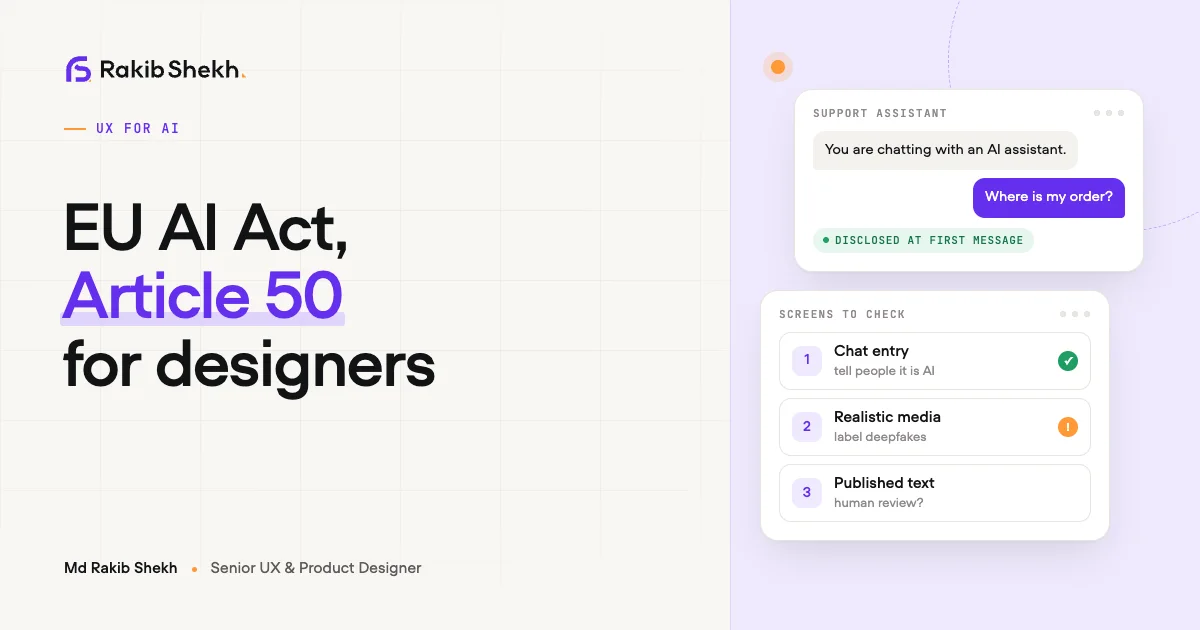
The transparency rules in Article 50 of the EU AI Act apply from 2 August 2026, according to the European Commission. Most of what you will read about them is written by lawyers. I design AI features for a living, so this is the designer reading: which screens carry a duty, what "obvious from context" means in a layout, and what to bring to your lawyer. It is not legal advice.
As of October 2026, here is what I could confirm on official sources. Where I could not, I say so.
What does Article 50 of the EU AI Act actually require?
Article 50 sets four transparency duties, plus one rule about how the information must be shown. The text is on the Commission's AI Act Service Desk and in the Official Journal.
| Paragraph | Who | What it asks |
|---|---|---|
| 50(1) | Providers | Design systems that talk directly to people so those people know it is an AI, unless that is obvious from context. |
| 50(2) | Providers of generative systems | Mark synthetic audio, image, video and text in a machine-readable way so it can be detected. |
| 50(3) | Deployers | Tell people exposed to emotion recognition or biometric categorisation how the system works. |
| 50(4) | Deployers | Disclose deepfakes, and AI-generated text published to inform the public on matters of public interest. |
| 50(5) | All of the above | Show the information clearly, at the latest at first interaction or exposure, and make it accessible. |
A provider builds or sells the AI system. A deployer uses it in a product or service. If you wrap someone else's model in your own app, you are probably a deployer for some duties and, depending on what you ship, a provider for others. That split is a question for your lawyer, not for a designer.
Which screens in my product need an AI disclosure?
Any screen where a person talks to an AI as if it were a person, plus any screen that publishes a realistic AI-made image, video or audio clip. Here is how I would walk a product.
- Chat and voice entry points. Support bots, assistants, phone agents. This is Article 50(1). For a voice agent, I would put the disclosure in its first sentence, because there is no screen to carry it.
- Generated media that looks real. A realistic image, audio clip or video of a person, place or event that could pass as genuine falls under the deepfake rule in 50(4). Evidently artistic, satirical or fictional work gets a lighter duty: say that such content exists, in a way that does not spoil the work.
- Published text on public-interest topics. If you publish AI-written text to inform the public, you need to disclose it, unless a human reviewed it and a person or company holds editorial responsibility. A private "summarise this note" button is a different case. In my reading it is not what 50(4) targets, but check.
- Emotion or biometric features. Anything that reads emotion from a face or voice, or sorts people by biometric traits, needs a plain explanation of how it works. Treat these as a separate legal review.
Machine-readable marking in 50(2) is mostly invisible. It sits in the file, not on the screen. Your design job there is small: do not strip it on export, and do not promise users it is a visible badge when it is not.
What counts as "obvious from context"?
The law says the disclosure can be skipped when the AI nature is obvious to a "reasonably well-informed, observant and circumspect" person, considering the circumstances and context. That is a high bar to rely on in an interface.
My view: do not build a design that only works if the exception applies. A sparkle icon is not obvious to everyone. A chat window with a human name and a photo is the opposite of obvious. If the cost of one line of text is nothing, write the line.
The Commission published guidelines on Article 50 on 20 July 2026. The Commission describes them as practical guidance for authorities, providers and deployers. I only read the landing page, not the full document. Your lawyer should read the full text before you lean on any "obvious" argument.
How should the disclosure look?
Show it before the first message or output, in plain words, in a form screen readers can read. Article 50(5) says the information must be clear and distinguishable, given at the latest at first interaction or exposure, and must meet applicable accessibility requirements.
Here is what that means in practice:
- Put it first. A line above the first message beats a footer note that appears after the third reply.
- Use words, not just an icon. "You are chatting with an AI assistant" does the job. An icon can sit beside it.
- Make it readable by assistive technology. It should be real text with a proper name, not an image.
- Translate it. If the product is localised, the disclosure is too.
- Do not bury it in terms of service. That is not "clear and distinguishable" in any layout I know.
For visible labels on generated media, there is a voluntary Commission tool. The Code of Practice on AI-generated content covers marking for providers and labelling for deployers, and the EU offers a set of optional icons for deepfakes and for AI-made text on matters of public interest. The Commission describes the code as an adequate voluntary tool, and signing it is optional. Where the label goes and what it says is a design job of its own, and I will cover it in a separate post.
What changed with the AI Omnibus?
The Commission's AI Act page says the "AI Omnibus" entered into force on 27 July 2026. It moves the high-risk Annex III rules to 2 December 2027 and the Annex I product rules to 2 August 2028. Article 50 still applies from 2 August 2026.
There is one transition for marking. Under Article 111(4), added by the Omnibus, providers of generative systems placed on the market before 2 August 2026 have until 2 December 2026 to comply with Article 50(2). The Commission's AI Act timeline shows the same date. It covers machine-readable marking only. The disclosure duties in 50(1), 50(3) and 50(4) are not part of it. If you ship a generative feature that existed before August 2026, ask your lawyer whether this applies to you.
What should I ask my lawyer?
Bring a short list, with screenshots of the flow. These are the questions I would ask:
- Are we a provider, a deployer, or both, for each AI feature?
- Is our assistant's AI nature "obvious" in context, or do we need a disclosure line?
- Does any generated image, video or audio we show count as a deepfake?
- Does any AI-written text we publish count as public-interest text, and who holds editorial responsibility?
- Does the 2 December 2026 marking transition apply to features we shipped before 2 August 2026?
- Do we sign the Code of Practice, or document our own measures?
If you work in a small team, start by listing every place the product speaks or generates something. One page is enough. My work page shows the kind of AI features I design.
FAQ
Does the EU AI Act apply to a company outside the EU?
It can. The Act covers providers and deployers whose systems or outputs are used in the EU, not only companies based there. Check Article 2 of the official text with a lawyer for your case.
Do I need a label on every AI-generated image?
No, not by Article 50 alone. The visible duty in 50(4) targets deepfakes, meaning realistic content that could pass as authentic, with lighter rules for evidently artistic or fictional work. Machine-readable marking under 50(2) is a provider duty.
Is signing the Code of Practice mandatory?
No. The Commission calls it a voluntary tool. If you do not sign, you must show your own measures are adequate, and authorities assess that case by case.
Is this legal advice?
No. I am a designer, not a lawyer. I read the Commission's pages and the Article 50 text, and I have tried to say where I stopped.